To the degree that we engage in an activity purely to achieve some end, or goal, which is separate from the activity itself, that activity is not play. What we value most, when we are not playing, are the results of our actions. The actions are merely means to the ends.In play, however, all this is reversed. Play is activity conducted primarily for its own sake. The playful student enjoys studying the subject and cares less about the test. In play, attention is focused on the means, not the ends, and players do not necessarily look for the easiest routes to achieving the ends.
Monday, August 23, 2010
Does Anyone Actually Play an MMORPG
Sunday, August 22, 2010
Lanchester’s Laws and RTS Design
(I’ve been playing a lot of World of Tanks lately. I can’t talk much about it because of the NDA, but as soon as the open beta rolls around I will make a post about the game.
I have a few other articles I’ve written this month that are awkwardly close to completion. Hopefully I’ll get them up soon. Here’s a short post to tickle your brain while I put together more substantial content.)
Predicting casualties is easy when two even-skilled sides are fighting in melee, says Lanchesters' Law:
In ancient combat, between phalanxes of men with spears, say, one man could only ever fight exactly one other man at a time. If each man kills, and is killed by, exactly one other, then the number of men remaining at the end of the battle is simply the difference between the larger army and the smaller, assuming identical weapons.
But what about when units with ranged weapons engaged? The same simple model can no longer hold.
With firearms engaging each other directly with aimed fire from a distance, they can attack multiple targets and can receive fire from multiple directions. The rate of attrition now depends only on the number of weapons firing. Lanchester determined that the power of such a force is proportional not to the number of units it has, but to the square of the number of units. This is known as Lanchester's Square Law.
This fact is of critical importance for RTS design. Games that mix melee and ranged combatants can face strange balance issues that arise because of asymmetric forces of melee and ranged combatants combining in different ways. Ranged units may be balanced against one another, but when melee units are added the balance is damaged more than the addition of another ranged unit would have.
In games that consist entirely of ranged units, like Company of Heroes, balance is a fickle thing. When developers make even a small change to a unit’s capabilities, the squared effect of that change can cause ripples through the entire metagame and cause certain crazy strategies to become viable (pioneer spam was one such issue in CoH).
This fickleness applies to both unit strength and the cost of units. Adding to a numerical advantage by cheapening a certain unit for one faction in an RTS can cause very severe issues if the other faction isn’t also adjusted, because the asymmetry will cause a much larger effect on the battlefield than most anyone will expect.
Wednesday, August 11, 2010
No Bore Core
Saturday, July 31, 2010
Air Units in land-based RTSes
Air units are a source of tremendous cognitive dissonance in RTS games. As a metaphor, air units usually seem awkward. They hover in the air infinitely or, if the developer wants to be "realistic", they fly to accomplish some objective and then run out of fuel and ammo and have to fly back and land again. The sorties usually do not see units going too far afield, which makes sense considering air units that would realistically go 100x the speed of ground units instead travel at barely double their speed (at most). In terms of game mechanics, seldom do air units make sense and offer balanced viable options for a player. Air units often are the most powerful units in the game (Battlecruisers and Carriers in Starcraft, bombers that can level base buildings in one run in RUSE) if they are allowed to be built on-map and are treated as units.
Land-based RTSes are generally based on map control. The map is critical to how the game unfolds. Where are resources? Where do players start? Where are the impassable boundaries the players have to work around? All of this is circumvented by air units. Air units generally do not exert map control unless they're implemented simply as ground units that ignore terrain. Ignoring terrain is, itself, an issue in games where much of the interesting strategic choice blossoms from terrain.
When given the viable option at the beginning of a match, a player should almost always choose air units before they begin to use ground units to cement map control. An air unit that is equally as effective as a ground unit at ground attack is significantly more valuable in that it can ignore terrain to harass the opponent from any angle. Since games have a sharp divide between units that can shoot air units and units that cannot, the early game units generally are putrid at air defense. If they were good at air defense, then air would never be a viable strategy because building basic units would hard-counter it.
Most standard RTSes circumvent this problem by requiring a bit of tech research before the player can buy air units, or by nerfing air units to the point where they are weak enough to not be much of a threat unless massed. Both approaches remove air from viability in the early-game. The best approach to air unit design allows air to be effective and viable throughout the entire game--or at least until the opponent builds counters.
Air units are too fast and too long-ranged to be presented effectively with similar mechanics to ground units in most RTSes. Unless the game is on a very broad scale--a scale which is very rarely attempted in RTSes--air units will not fit into the balance of the game. The speed of air units can cause then to be a must-have in the early game because they can project force much farther and much faster than any other unit and then run away from danger just as quickly. The advantages of going air may be too great for competitive palyers to pass them up, as they were in RUSE during open beta, which leads to the set of viable builds being constricted because the player needs to build air (or a significant amount of ground-based anti-air) first.
There are two ways to "fix" air units in land-based RTSes.
The easier but less satisfying way involves making all air units act as if they're nothing more than ground units that ignore terrain. These air units have to have speed comparable to land units, or perhaps be slower, to avoid obsoleting ground units.
The best way to solve this problem (at least that I've encountered) is to make all manifestations of air power into special abilities. "Off-map" air. Company of Heroes does this to great effect. The key is to not make on-map anti-air units required or common. Give otherwise-useful units the ability to shoot down planes if the planes take certain paths. For instance, the flak 88 in Company of Heroes is a powerful, long-range anti-tank gun primarily, but also acts as a supremely powerful anti-air gun that can shoot down a plane in one volley. As long as air use is relatively rare in the context of the game, making all air units off-map call-ins tremendously increases the seeming realism and fun of air units while doing nothing to damage the metagame.
Friday, July 9, 2010
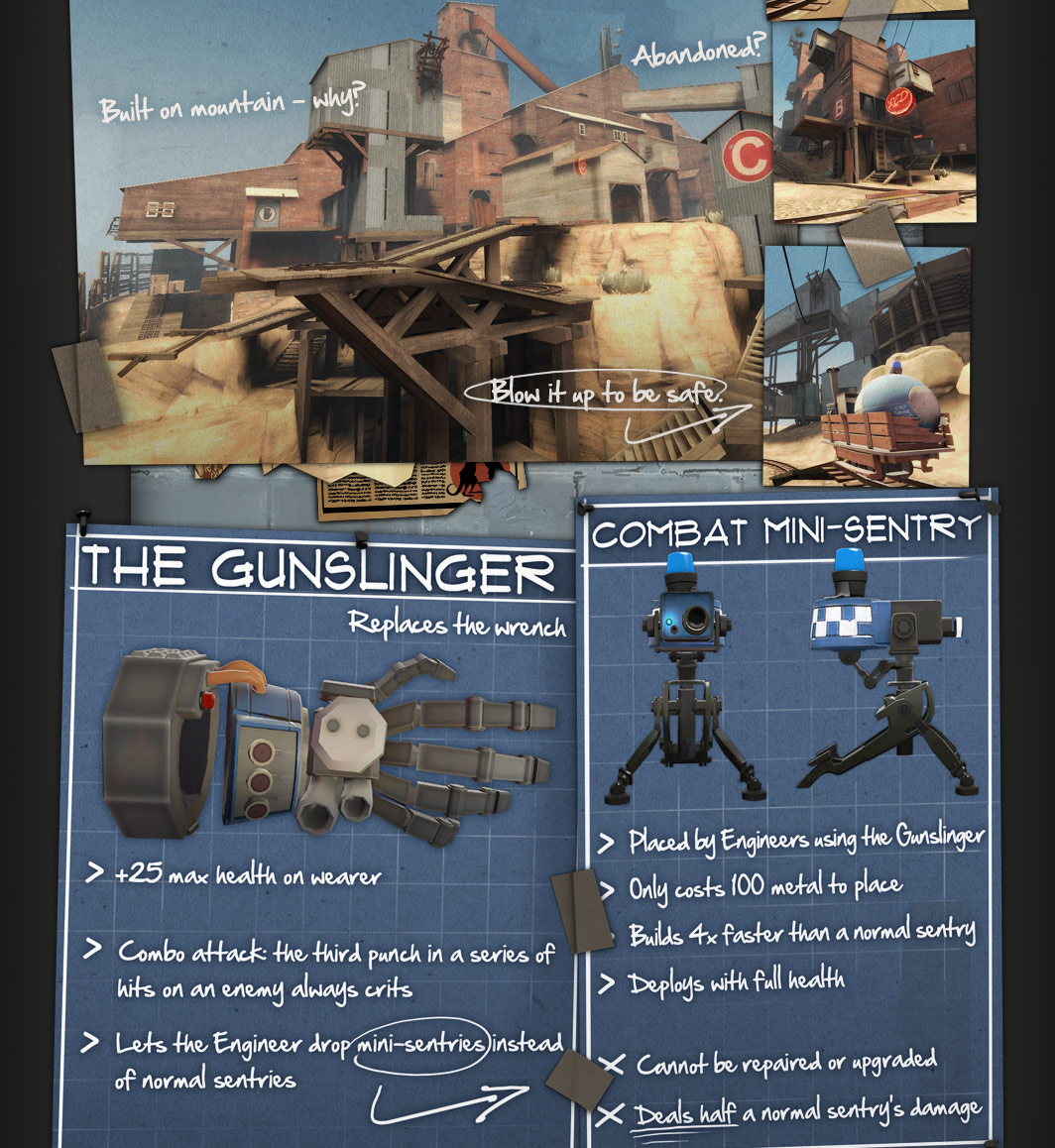
Engy Update is Credit to Team

Thursday, July 8, 2010
What Blizzard Should Have Done
- a real name which is as global as it gets;
- a player handle which unifies a player identity across characters and Blizzard games;
- and a character name (or player alias in the case of non-RPGs).
Fundamentally, privacy is about having control over how information flows. It's about being able to understand the social setting in order to behave appropriately. To do so, people must trust their interpretation of the context, including the people in the room and the architecture that defines the setting. When they feel as though control has been taken away from them or when they lack the control they need to do the right thing, they scream privacy foul.
Zuckerberg and gang may think that they know what’s best for society, for individuals, but I violently disagree. I think that they know what's best for the privileged class. And I'm terrified of the consequences that these moves are having for those who don't live in a lap of luxury. I say this as someone who is privileged, someone who has profited at every turn by being visible. But also as someone who has seen the costs and pushed through the consequences with a lot of help and support. Being publicly visible isn't always easy, it's not always fun. And I don’t think that anyone should go through what I've gone through without making a choice to do it. So I'm angry. Very angry. Angry that some people aren't being given that choice, angry that they don't know what's going on, angry that it's become OK in my industry to expose people. I think that it's high time that we take into consideration those whose lives aren't nearly as privileged as ours, those who aren't choosing to take the risks that we take, those who can't afford to. This isn't about liberals vs. libertarians; it's about monkeys vs. robots.
There was a time when Blizzard was viewed as a company run by and for gamers. That time is now over. Even aside from the wrongs or rights of the proposal, no company that fails so badly in understanding gamer culture can really claim to be one of us any more.
Saturday, July 3, 2010
HiRez Saves Global Agenda
HiRez announced last week that Global Agenda will never charge players subscription fees. Global Agenda will follow the same business model of almost every game in existence: Charge for the box and then charge for expansions. The only twist is that they’ll offer token- (to buy loot with) and XP-boosting services at relatively low real-money prices.
Why did this happen?
AvA was supposed to be the key selling point for the subscription. AvA is a garbage mode. It’s not a good competitive mode and you can’t be competitive in it as a casual. AvA satisfies no one, and there are no fixes forthcoming. On the US servers, one alliance (JL) dominated. Your choices were to join them or lose. The mode only rewards first-place finishers, so competition is shelved in favor of collusion—this renders AvA a complete joke as a competitive mode. HiRez made an attempt to improve AvA by putting everyone into one huge zone with player-set territory opening times instead of having multiple independent geography-based zones that are only open for two hours a day at various times of day and night. This decision led to JL dominating the entirety of AvA instead of just a couple of US zones. AvA went from bad to pitiful in 1.3A, and AvA was the main reason why people would subscribe—at least theoretically.
Without AvA to draw players to the subs, why would players bother? There are only so many good-spirited people who would blindly throw their money at HiRez in the hope that they might get value in return. The potential low number of subscribers would have crippled all of the other subscriber content, each mode of which would have required queues to be busy enough for matchmaking to happen. None of those modes alone—and probably no combination of those modes—would justify paying a subscription (there were two arena, full arranged team modes and a PvE mode). The fact that matchmaking may not even be possible because of a low population of subscribers means that if matches were made, they would be terrible due to the matchmaker being starved of players at different skill levels to match-up.
A Bright Future?
I still don’t have much confidence in HiRez after the half-assed attempt to MMORPG-ize the game in 1.3A. I think that the decision to remove the subscription was necessary to avoid the game completely dying. Now players can reasonably have some hope for the future of Global Agenda. What HiRez will do with that future, we will see.
Current indications show that they are going to continue on the path of adding other diversions that will extend the number of half-baked things that you can do in the game—they’re adding “open-world'” zones in the next patch. I have no confidence that the “open-world” zones are going to be sufficiently “open” to please anyone; early indications show that zone populations won’t break 50. And HiRez had to spend a lot of time and resources reworking the UT engine just to get this excuse for an open world off the ground, let alone fun. Such poor benefit-per-cost decisions don’t bode well.
I have severe reservations about GA, but at least I know now that it will survive to see something of its potential. If HiRez polishes and builds on the strong points of the game instead of implementing, in an expensive and time-consuming way, half-assed MMO-impersonation features, they would have a much brighter future ahead.