Showing posts with label combat. Show all posts

Friday, July 20, 2012

Uncapped PvE Content and Prestige

Spinks pointed out the irony of WoW's 10-man raids: namely that the raids are too small to sustain a guild around a 10-man raid team. Raids were reduced in player count because of logistics and accessibility concerns. Now they are so small that they cause logistics and accessibility issues. /ironic

This reminded me about uncapped PvE content. WoW used to have uncapped encounters in the form of world bosses, and it will be getting some new ones in Mists. Rifts are uncapped, as well as other forms of Public Quests. PvE content in Eve has no player count limit. Many of the original raids in EQ and FFXI were also uncapped.

It's important to note that there are no "balance scaling" mechanics in these systems. Mobs don't receive extra HP with every player at the fight. Nor does more money or gear drop depending on the raid size.

There are some advantages to unrestricted PvE encounters:
  • Bring as many friends as you want. No one has to be second string or on the bench.
  • Bring as few friends as online. You don't need to cancel the raid if one player doesn't show up, because the encounter is not necessarily attuned for X number of players.
  • Risk and Reward are inherently balanced. Larger the party, the less risk involved, but fewer payouts per person.
  • Challenge is self-ordained. Make the fight as easy or hard as you want.
  • Pick-up-groups could do any content. ++Accessibility
I see four reasons that players raid:
  1. Story/Content
  2. Power (e.g. character progression, money, gear)
  3. Challenge
  4. Prestige
Players interested in fulfilling the needs of Story, Power, and Challenge will have their needs met by the uncapped system. Players can easily experience any content they wish; they simply need to bring enough bodies. They can toy with risk and reward to modify the power payouts. And they can adjust the difficulty by inviting a different number of raiders.

Those seeking Prestige, however, will not be happy with an uncapped raid. If the encounter were a signal of prestige, and because of its challenge or accessibility, predicates that the access or completion of the content is rare, then Prestige players would want as few people in that elite club as possible. The scarcer the resource, then the more valuable it is deemed. The rarer the achievement, then the more distinction it bears. 

Some times there is confusion regarding the difference between Prestige and Challenge. Prestige certainly can and often does derive from Challenge. If a task is difficult, then fewer people are capable of completing it, thus making the success rarer. But Prestige can come from a time commitment: e.g. level 99 in Diablo 2. If everyone were dedicated enough to reach level 99, it would not be prestigious (like level 85 in WoW).

The Achievements you unlock, the gear you wear, and the stories you tell are trophies that signal your prestige. The more people with those trophies, then the less special they are. But the players seeking content, money, and challenge will all be having fun.

From a development and design perspective, less time needs to be allocated to meticulously balance and rebalance fights. Obviously the encounter payouts need to be in line with other content so that players have an actual choice. But there is no need for a scheduled nerfing or complex algorithms that adjust the difficulty based on the number of players. Let us decide our level of risk, reward, and challenge.

Monday, December 26, 2011

World PvP: A Common Model

World PvP comes in many forms, yet there is a simple environment model that gets used over and over again. It can be seen in World of Warcraft, EVE, Darkfall, Dark Age of Camelot, and many other past and future games.
  1. Rewards for engaging in PvP.
  2. Risk associated with entering "PvP" areas.
  3. Non-PvP content/rewards in those areas.
This simple list describes Isle of Quel'Danas, Tol Barad, and world bosses in WoW; low-security space in EVE; dungeons in Darkfall; Passage of Conflict in DAoC; and any resource node or choke point in any MMORPG with PvP capabilities ever.

Rewards include crafting materials, mob access, safe passage, money, abstract currency (Honor), and loot. Note that territory control is not a reward in itself--owning land for the sake of owning land is meaningless and players will not value that "resource" unless it gives them an advantage or creates wealth/value, including vanity (player houses). Territory control is often an objective in competitive multiplayer games, but at the very least players win the game by claiming control--most MMORPGs are not "won". Compare the difference in activity between the Zangarmarsh control points in BC WoW (gaining a +5% experience boost in the zone), to the Spirit Towers around Auchindoun (allowing bosses to drop Spirit Shard currency). [TC rant over...]

Risk is "exposing (someone or something valued) to danger, harm, or loss". Something must be risked to have infectious PvP. It could be as minute as lost time on a corpse run, or as harsh as the entire net progress of your character (permadeath). The severity of the potential loss directly correlates to the emotions conjured during those risky situations. The more the player risks, and thus the greater the consequences, then the more intense the emotions associated with PvP events (fear, thrill, fiero, agony, anger). Adrenaline can be addictive and binds players to the game (or makes them run in terror). "What a rush!"

People are risk adverse and are afraid of losing value. But the beauty of MMORPGs is that none of it matters! It's all make-believe.

Make-believe squid-monster riding giant eagle-horse.

The Non-PvP content in the zone attracts "grazers": players that are not looking for a fight, and will be tackled by a tiger if they don't pay attention. These players serve as content for the hunters (and the hunters provide thrilling experiences for the grazers--hooray symbiosis!). If this hunter/hunted paradigm is used, it is a good idea to include tools that allow players to evade or to truly hunt other players (foot tracks, dead mobs, chat, scanners, etc.).

Do not think that grazers are innocent victims. Players will alternate between hunters and grazers rapidly depending on what their immediate goals are. Also, longer term grazers ("carebears") who engage in risky behavior to amass rewards at an accelerated rate are the ones trying to cut corners. ;)

Assuming players are frequenting zones that follow this model, it is likely that World PvP will foster. The combat itself has to be vaguely interesting in order to motivate players to use it, so dull combat can thwart any attempts to create this environment. World PvP is an emergent dynamic and a powerful aesthetic of combat, aggression rules, and scarce resources. The fundamental mechanics need to be solid first.

Wednesday, August 11, 2010

No Bore Core

I have a very bottom-up approach to game design. I like to think in terms of fundamental, atomic, core mechanics, and build them up in layers to produce a cohesive system.

After making those minigames for my cancelled Facebook MMORPG, I am fairly confident that there are 2 types of "core" mechanics: mathematical and pattern matching. My evidence is purely anecdotal, but after observing players for several months, I believe that pattern matching is a superior mechanic for video gaming. I attribute this to the amazing subconscious pattern matching and recognition facilities in the human brain.

Pattern matching as a mechanic is usually coupled with input device mastery. Two prevalent forms of PM are shooters (click the button when a target lines up with the reticule) and rhythm games (click the buttons in sync with an auditory cue). Both these games involve some sort of prediction, e.g. leading targets, interpolating target location, and maintaining musical beat/rhythm.

To help understand the difference between pattern matching and straight up input device mastery, think of any implementation of Whack-a-mole (any WoW addon for a support role will work). The mole surfaces at random locations (debuffs are placed on random raid members), and the player hits the mole (clicks the grid to decurse the target). There is no prediction, pattern, rhyme or reason to where the moles will appear. The player simply invokes muscle memory to move the mallet to a location and swings her finger.

If we examine the shooter mechanic stack a bit more, the very next layer on top of pattern matching in most shooters is resource management (which is a mathematical mechanic). Ammo, weapon clips, reload time, and health--these are all resources that are managed by the player.

I thought this would be an interesting template for RPG combat, and thus I arrived at "ability clips". The entire system would be mirrored from the standard shooter weapon system: the player primes spells in much the same way that weapons are reloaded; when the player depletes a clip, they must reload using a reservoir of mana; each ability has its own reload time, clip size, mana cost, etc.. Players can only have 1 active ability in the very same way that players only have 1 active weapon. The game becomes a third-person shooter with guns that shoot health buffs and movement snares.

There are already a few games that play with functional abilities on weapons. Global Agenda was one. Many of the devices in GA were some sort of non-damaging spell, e.g. speed boost, restore health, stun buildings, and forcefields. Its combat was great; it could have been an amazing example of what I advocated above if Hi-Rez decided to pursue the shooter side rather than muddy the gameplay with hollow additions like persistence, progression, and gearing.

Team Fortress 2 is also an unlikely example of an ability shooter. The interface for swapping weapons isn't as robust and clean as GA's, but many of the newer items added to the game perform a non-damaging ability. The Demoman has a shield which reduces explosive damage and gives them a Charge ability. The Sniper can equip "jar based karate" (it is a jar of pee), and toss it on enemy players to increase their incoming damage by 35%. It also reveals cloaked Spies and puts out fires. Spies have several items which change their cloaking behavior. Heavies can restore health with Sandvich.

Of course these are PvP games. Could an ability shooter work against dumb computers? Players in GA ran PvE missions for the phat lewtz, so I am not entirely sure that those missions without progression rewards are fun. All the mobs did was shoot (from what I remember). If they had a wider range of abilities, maybe it would be a bit more interesting.

Combat as an ability rotation is dull and a precursor to grindful play. The design goal should be to provide the player with interesting decisions, and those require interesting situations. The game must constantly test the player's knowledge and demand that they react, not simply act.

So what other sorts of pattern matching cores could be used to build a combat system? It does not necessarily have to be real-time, but it should have the potential to place players in interesting situations against AI. Some other constraints to think about involve porting the system to an MMORPG, namely how much volition does the player have if set in an open world (player state can't be reset easily; what happens if the player engages more than 1 target).

And if you are interested in passing some time, you can take a look those prototypes. A game of particular relevance is StrongMan. It does have a superficial score attribute tacked on to give feedback to the player, so it is not a pure example of a pattern matching game, but it is pretty close.

Tuesday, June 29, 2010

Coupled Combat Systems

I'm going to mention FFXI again in this post, but it's not about FFXI. I promise!

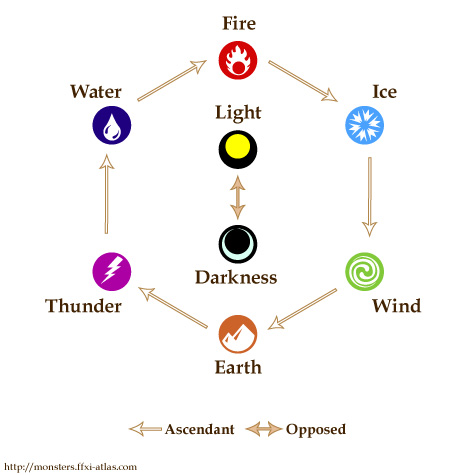
There are many systems going on under the hood in FFXI's combat. The world has a week cycle which progresses through 8 elementally-aligned days; each day lasts about 1 Earth hour. Each spell has an element associated with it, and using the skill during the element's day or the day that is weak to the skill's element will cause the spell to be more effectual. The other side of the coin is that if that spell in casted during the day that is strong against that spell's element, then the spell will be less potent.

Weapons have damage types which grant bonuses or dampen damage against certain foes. Popular leveling locations at the moment are filled with Colibris which are weak against piercing attacks. Thus Dragoons and polearm-weilding Samurai are hot jobs right now.

Less pervasive knowledge, but still important to those that can exploit it, the mobs themselves have a counter system. Attacking a bird with a crab wouldn't be a Beastmaster's first choice.

It's not the end of the world if a Dark Knight (using a Scythe) is invited to a Colibri party or a mage casts Fire II on Watersday. These are intricate systems that provide slight advantages (or disadvantages) to those who understand and capitalize on situations. Over a long enough timeline the optimizations add up, rewarding those who are more knowledgable, but sometimes it is unavoidable--healers will still cast Cure on Darksday regardless of the 10% less potency.

These systems make combat more nuanced--more mechanics to be learned and applied on the road to mastery. Spell rotations and weapons have more considations than just DPS at face value. Melee classes maintain several different weapons and use the appropriate blade depending on party composition and camp location. Monsters have more dimensions than just HP, and thus the world has a bit more personality and feels more alive.

How did we let studios remove these types of systems? Was it deemed too much baggage to get on the treadmill? Too complex for plebian minds?

Monday, June 7, 2010

Analysis of FFXI Combat


Several people have asked me what makes Final Fantasy XI's combat "difficult". Thinking about it for awhile I've uncovered that choices have such an impact in the course of battle that the player has little room for error. This doesn't really tell you too much about the game though, so I am going to describe a few characteristics of FFXI's combat as well as some points of reference. This article will primarily focus on combat from a caster's point of view, but melee and ranged classes are also faced with difficult decisions. Abilities which temporarily boost damage output can kill an overzealous player if he/she pull aggro. There are jobs with positional abilities and combos. LotRO fans will recognize FFXI's Skillchain system as Conjunctions/Fellowship Maneuvers.

FFXI is slow. The whole game is. It is from a generation when MMORPGs were still worlds. Pretend that you are waiting 10 minutes for the boat to arrive in Mhaura while you read this (and then take a 12 min ride to your destination). Cast times, cooldown, and weapon swing delays are all several seconds long. All the spells in the Cure line (the quintessential healing spell) have 2 second cast times and 5 second cooldowns. Weapon delays are measured in frames, and the server runs at 60 frames per second. So a 600 delay Scythe has a 10 second swing time. And it will miss.

There is no natural HP or MP regen in FFXI. Resting regains these resources, but only after 20 seconds do they begin to tic upward. Resting is cumulative, so the longer a player remains resting, the more MP and HP is restored on each successive tic (with 10 seconds between each tic). Kneeling to rest and standing back up have animations which lock the character in place. Each animation is approximately 2 seconds long, and a player cannot move nor preform any action until they are completely standing. It is not possible to pop up instantaneously and toss a PWS on a critically wounded party member. Players must play with several seconds of foresight and judge when to stand and when to rest.

A Team Fortress 2 friend of mine (Hi Polonius) says that he enjoyed healing in FFXI the most out of every MMORPG he has played because of its difficulty in judging when to rest and when to actually cast those Cures.

The game is filled with tiny nuances in play like the resting animations. The player is technically still resting during the standing animation, and it is possible to get a final tic while straightening up--a skill that requires impeccable timing. Even to chain cast spells one after the other, the player must learn cooldowns and casting animations. Using animation hints like these makes the game feel like a Fighter at times. There are many more places of mastery than just animation hinting.

Buffs and debuffs are immensely powerful; so much so that there is one class dedicated to them: Bard. Debuffs on mobs increase the effective HP of the tank and the DPS of the damage dealers. They can make a party extremely efficient, killing for 3 hours without stopping. The Red Mage's repertoire of white and black magic (particularly buffs and debuffs) as well as some Red Mage onry buffs make it perhaps the most powerful solo class in the game (as 75 RDM/Ninja).

Red Mages also get FFXI's only set of pimp gear.

Some may point to WoW's buffs/debuffs. I will agree that WoW's debuffs are very important to the group or raid, but how many players bother to stack Expose Armor, cast Curse of Elements, or even Judgement on trash mobs? Parties burn through them so quickly, it isn't worth it. Even while leveling or farming, unless the player is fighting a mob of +3 levels or an Elite, she would be more efficient to just do damage. Most of the experience parties in FFXI take 1 or 2 minutes to kill a mob. That is plenty of time to reap the benefits of status effects. Debuffing also generates tons of threat even if the spell is resisted. So if a player casts 3 debuffs and then immediately starts a nuking rotation, they should prepare to pull aggro.

Perhaps the consequences for failure in FFXI artificially make the choices seem more important. This may just be another lesson in risk aversion, but the other side of the spectrum seems to be Achievement frenzies, and personally I'd rather have risk-reward cycles. If I die in FFXI, I lose experience--the question is how much. Becoming "incapacitate" removes ~10% of the experience required to level from your current total. E.g. I have 802/10400 EXP. Dying would remove 880 EXP, dropping me to -78, at which point I would delevel and be at 9122/9200 EXP. I can lie on the ground for 60 minutes until I automatically return to my homepoint. If someone casts Raise on me, I will get 50% of the lost EXP returned (440), and be restored my level (leaving me at 362/10400 EXP). Raise 2 will give 75%, and Raise 3 will return 99% (but is a level 70 White Mage spell). As anyone with any insight into death penalties will say, this is simply a loss of time. But it stings. And letting party members die might label you as a lousy player. The reputation hit in a group-focused MMORPG is more severe than a few hundred EXP.

Bunch of us eating dirt.

By now I hope I've illustrated how little room for error there is and the punishment for failure. An unfortunate characteristic of RPG combat is the reliance on gear. I've heard players say that FFXI is 10% gear and 90% skill, but I find that breakdown to be very off. Melee damage dealers without Accuracy gear will miss. No amount of skill will make that Random Number Generator be nice. The same is true for debuffers who will want to stack Mind, Intellect, or Charisma respective of the spells they cast. Most of the time, players can get by with the cheap versions of this important gear, and perhaps that is what the 90/10 comment was referring to, but there is a noticeable difference between someone with cheap gear and someone wearing a few million gil.

One more thing I will mention is that Square-Enix is very secretive about mechanics in FFXI. I call it a Hidden Information policy. Nine years since FFXI came out, the developers have never actually told the players what stats do. Players have experimented and inferred what purpose Strength has, for example, but I doubt we will ever know the full extend of STR's influence (certain weapon skills receive bonuses from different stats).

Even though FFXI's combat is slower paced than most moderns MMORPGs does not mean it is boring or uneventful. On the contrary, players have time to think and make important choices. Because players are not simply reacting to stimuli on the screen as they would in a faster-paced environment, the developers have created little room for error. Fewer actions are executed in FFXI than in WoW, but each one of those actions (or inactions) carry immense weight and could mean the difference between 10k EXP per hour or losing 45 minutes of your time.

And those of you who like WoW Talent theorycrafting, look up a subjob discussion. There are 362 job permutations in FFXI, and players can change gear while in combat.

Here are some videos of experience parties:

Friday, December 4, 2009

Suddenly, Bioware is Incompetent.

This is one of the few times I’ll jump on an issue that is a hot topic on MMO blogs. I’m doing it now because certain prominent bloggers’ opinions on this topic have been too ridiculous for me to bear. Perhaps Keen’s numbers haven’t been good recently and he wants to start a huge debate to draw links and views?

Bioware has released information on companion characters. For some unknown reason, this fact has led people to believe that Bioware cannot tie their design shoes anymore.

With very little actual information available, people are assuming that Bioware are going to mangle the design of companions and ruin their game by removing one or more “M”s from “MMORPG.”

Arguments against companions:

  1. It throws off rewards because you will get loot as if you were two players.
  2. Who would choose to bring someone along if they’ve already got an AI companion?
  3. Everyone will always have their companion out, so the game will be balance for that, rendering non-companion strategies non-viable.
  4. The game won’t be balanced for rampant companion use, so the game will fall apart as everything becomes extraordinarily easy due to companion use. This makes non-companion strategies non-viable.

All of these complaints are ways of saying that Bioware suddenly is incapable of good design. With even a modicum of thought I can come up with ways to counter every one of those arguments with game mechanics that are easy to implement. This isn’t difficult work or hard thought—this is basic stuff that any self-respecting game designer (or MMO pundit) should be able to figure out.

  1. Parties get loot based on the number of PCs in the group, as done in DDO.
  2. AI companions will always be inferior to players because AIs just aren’t that good at positioning and tactics. As long as NPC companions occupy group slots that players would otherwise occupy, PCs will be preferable over NPCs.
  3. Pet classes already exist in MMOs. Even if the design isn’t great, you could just treat every class in SW:TOR as a pet class. This isn’t great design—but it’s the worst case scenario.

DDO has already implemented a feasible and functioning companion system and the world hasn’t exploded. Why can’t Bioware do the same?

This is yet another instance of people throwing a tantrum because they are incapable of seeing past the tip of their noses. Here, on bold display, is the common approach that everything with which I am not familiar is poison and evil. This kind of punditry is damaging to the discussion and progress of MMOs.

(You should also read Andrew’s great concise post at Of Teeth and Claws. There's also a strong post over at Player vs Developer that further shows good signs for companion systems.)

Thursday, September 24, 2009

Meta-PvP: A Strength of Victory System

I’ve been toying with the idea of a PvP MMO game that doesn’t involve players fighting one another directly.

The game would consist missions that players can undertake to combat other player factions or NPC factions. Missions could be initiated by players who run factions or NPCs. Each mission would involve a scenario or a set of scenarios where a player (and perhaps a few NPCs under his control to some extent) or group of players fights a group of NPCs of the opposing faction while trying to accomplish various objectives. There would be multiple scenario types including “deathmatch”, escort, protect the item, obtain the item, etc. Certain numbers of each type of scenario would need to be completed within a certain time-frame to complete a faction-wide mission—for example, to take a city/town/hamlet/farm. As the sides complete scenarios, they are awarded points based on their performance in the scenarios. The side that obtains the highest score accomplishes their goal, be it defending or attacking.

Nowhere in this system are players required to lose a battle they participate in. The system actually works perfectly fine if both sides win every single encounter in which players take part. As long as the NPC AIs are good—and they might not have to be much better than Darkfall NPC AI with some added behaviorlets—players can enjoy playing through challenging content and succeeding without being teabagged by 12-year-olds while accomplishing broader, world-changing objectives.

Can a system like this allow people to have their dynamic world cake and eat it too without it being a newb-repelling niche experience? Could such a system bring dynamic world, sandbox PvP to the masses?

Sunday, August 30, 2009

Remnants of an Age Past

What shall be named The Mistake, I started playing It again. I was trying to save myself like a Kama Sutra monk, waiting for the Aion release (double entendre definitely intended). The last flirtation involved gallivanting through Northrend, an unexpectedly fun experience (pre-Tournament Icecrown is my favorite zone in all of WoW).

But this time I am trekking through Azeroth, all the old content, and I have come to a realization. I must call it a revelation, lest I get so frustrated at the bait 'n switch that I end my adventure here and now. I have finally understood that "killing with purpose" motto pronounced several times by the WoW designers. It's like the missing link between EverQuest and Aion. Newer quests are not as crude as 1.x WoW quests as to reveal this dark secret. I feel like I've discovered Ida.

Prior to WoW, mobs were simply grinded for experience points. You or your party found a camp somewhere and just killed mobs for hours. WoW quests are a layer of story on top of this grinding. The quest gives you a "purpose" to go an kill 100 boars, but you are still camping somewhere and killing mobs for hours. This is prevalent throughout much of 1.x WoW:
  • Recipe quests which ask you for several animal parts which would require you slaughter an entire field many times over.
  • Enemy stronghold quests which make you kill an entire cave of humanoids only to get a follow up quest to go back into the same cave and kill the leader (after all the mobs have respawned).
The idea of grinding mobs doesn't really go away; now there is bonus experience for doing the "purpose" layer.

I'm putting purpose in quotes because Blizzard seems to think that players just killed willy-nilly without rhyme nor reason prior to the Deliverance. Those xp camps had purpose: get experience points. And as I've said before, I enter some twisted, meditative state when I'm just farming mobs for an extending period of time. I also like xp parties, something I'm looking forward to in Aion.

Since the Enlightenment, Blizzard has seemed to have forgotten how things were and are addressing the outcry of monotony originating from the mistake of calling these story purposes "quests". We have bombing runs, vehicle combat, and other mini-games focusing not on "killing with a purpose" but on "fun".

Maybe we can change how bonus experience is distributed.

In FFXI, when you killed mobs within a time window of each other, you received bonus experience. It wasn't something to sneeze at; you could get upwards of 50% extra experience. What if we changed the quest experience system to something resembling the bonus experience system? Instead of stocking up on "Kill 20 Monkeys" quests, let's reserve the title of Quest for actual quests. When players start killing mobs in a certain area, give them a heads up as to how to acquire the bonus experience. Ask them to kill 10 mobs in 5 minutes; or 50 Rats total. Once they complete the objective, give them the bonus experience.

Of course this is assuming we have the standard, target-hotbar MMORPG combat system. A few months ago, I had envisioned a high-intensity combat system--somewhat of a throwback to Action RPGs. Characters have large amounts of AOE attacks, designed to cut through hordes of enemies quickly. Think of Diablo II. But instead of giving experience points just for killing mobs, we make the players run Gauntlets. Think of Gauntlets like instanced dungeons, with start and end locations and checkpoints along the way. Players receive bonus experience when they reach checkpoints and ultimately the end.

Simple. Fun. Flashy. Not monotonous like "Kill 30 Vultures". There is even the potential to record times of parties as they race to the end: have a leader board for the Achievers.

This originally was part of a grand territory control system, but as a middle layer game, what do you think?

Sunday, August 23, 2009

MMO Novelty and Social Networking

We are at a turning point in the MMO genre. It is a point which will bring about either the downfall or the pervasion of the grandest display of video games seen yet. Up to this point, I feel MMOs have survived entirely on the novelty of playing in a large, persistent world. Players were willing to do very un-game-like activities because that's just how it is in an MMO. By the time grinding catches up with them, they are bound to the world with social ties--guilds and friends they've played with over the months.

The novelty is wearing thin, particularly in the combat area. More and more MMOs are appearing to be copies of each other because developers can't get past those poorly designed grinds. Aion, Champions Online, Fallen Earth, SWTOR: all have the same combat system. And guess what? WoW pretty much popped the MMO cherries of any gamer who would begin to try an MMO. Please stop with the "tried and true" single-target, hotbar doldrums. If you stay down this path, then the only way gamers are going to migrate to your new world is if all his social ties move there, and you will lose that battle also.

I'm projecting my feelings for Aion, but I'm willing to bet other players feel the same way. Aion deviates little from the beaten path. The only way I will be paying for Aion is if several of my RL and gaming friends decide to play it.

The only feature I am looking forward to is grouping. Apparently you can kill monsters in groups as a means to get XP, which is reminiscent of EQ, FFXI, and all those aged MMORPGs. What I am afraid of is that this feature gets American-ized out, and the grossly optimal way to level is solo-play. Fewer players willing to group means fewer groups.

So should NCSoft remove my beloved parties, I will be very reluctant to start paying them. I'm not going to torture myself just to chat and play with my friends. If I'm that socially depraved, then I'll start using Facebook more.

And here's the kicker. With all the social networking outlets, with all the social apps and casual games found on all these sites, MMOs will become obsolete. That is, unless they offer something these venues cannot: engaging progression that can't fit inside a Facebook app. If players get the same rehashed game systems over and over, they will learn to stop trying new MMOs. Less players means less revenue, and for a world that requires millions of dollars to create and maintain, that is not a sustainable business model. MMOs will die out.

Sunday, August 9, 2009

Combat of Pure Strategy (Pt. 1: Introduction; Melee)

Mot introduced me to a game called GOPS (short for Game Of Pure Strategy). It’s an exceedingly simple game, but the results of the game are determined purely by strategy. It’s one of the few games that involves absolutely no element of chance while remaining non-deterministic.

I’ll give a general description of GOPS before continuing; if you’re familiar with the game, feel free to skip this paragraph. GOPS is best played by two players. The game pieces are three sets of tokens with value markings on them. Usually tokens are marked with values that start at 1 and increase in a regular fashion (it’d be interesting to have token values increase according to a power law or some other distribution—I haven’t experimented with it before). Each set of tokens is identical to the others. Each player claims a set of tokens, leaving one set left over. The left over set constitute a stock that will be contested by the two players through a simple bidding process. Bidding proceeds by a token being selected out of the stock at random, then both players play a token (simultaneously) of the value they wish to bid. Whoever bids higher claims the contested token. The tokens that the players bid are discarded. Play continues thus, with players bidding on each token in succession and the higher bidder claiming the contested token, until the stock is exhausted. Once the stock is exhausted (the players’ tokens will be exhausted at this point, as well), each player totals the values of the tokens they have won. The player with the highest total wins the game.

If my description doesn’t make sense, feel free to check out the Wikipedia article. Or this.

Several months ago, Mot and I had a series of discussions about fitting GOPS as a combat system for an MMO. I think it’d be great for melee combat, and with some modification it may also work for magic and ranged combat (I’ll cover ranged/magic in a later post).

No random numbers need apply. The system would be relatively simple, as well. Show the combatants the tokens they’re bidding on and give them a time limit within which they must select the token they wish to bid. Better melee characters can receive bonuses for winning certain kinds of tokens. There could be special tokens as well that could be injected into the contested slot (the player would press a hotkey to queue abilities into the contested slot in place of whatever token would otherwise have appeared) by either player in an attempt to perform a special attack.

Combat would be constituted of contests which are organized into rounds. Bidding on one contested token is one contest. Each contest would have a time limit of 5-10 seconds. Sets of 5 contests constitute a round of combat. Whoever wins the round (whoever has the higher total value of tokens won) deals damage to the opponent and performs whichever of their own abilities they had won during the round. A one-on-one combat may take 5-8 rounds depending on who is fighting. This would be slower-paced than most MMOs, but this is not a problem because I aim to emphasize tactical decision-making and not rely on twitch mechanics to keep the players aware.

Why have combat of pure strategy?
  • It reduces the role of chance to a bare minimum.

  • It gives players a good reason to pay attention to combat.

  • It is non-trivial to win a combat.

  • It is entirely based on the strategic thinking of the players—you lose because you make mistakes or misjudgments, not because the dice weren’t in your favor.

  • It creates micro-level tactical and psychological contests that are missing from most MMORPGs. It’s very satisfying to read your opponent’s bids and expend as few resources as possible to beat them.


Potential weaknesses:
  • Combat may become too long.

  • Players don’t necessarily want to have to pay attention to combat on a second-by-second basis.

  • The first round or two is a feeling-out period where the results may be not strongly correlated to skill (the players are still figuring out what the other’s strategy might be). If players don’t fight one another often enough or if players switch targets rapidly, the draw of the GOPS system is severely weakened.

I think it’s at least worth prototyping a pure strategy combat system. I see a tremendous upside and a lot of appeal for players who enjoy skillful play but still want an RPG-like experience.

Monday, August 3, 2009

From Absurd Gamism to Moderate Simulationism

If you’re unfamiliar with the Gamist-Narrativist-Simulationist Theory, please read the Wikipedia article before continuing.

I describe the current state of MMOs as unabashed absurd gamism. The game rules are so strict and so vaguely analogous to real life that the player is forced to suspend disbelief ad absurdum. The metaphors in MMOs are stretched so thin as to be entirely transparent. There’s not even the vaguest notion of realism, not even a modest smear of grit to mar the pristine landscapes that are otherwise dotted with any number of mediocre models there for the player’s pile of pixels to get stuck on.

The learning experience in MMORPGs amounts to becoming accustomed to the ludicrously tiny sliver of actions that your character can perform to effect a millionth of the tiny part of the world that is actually interactive and not just painted adamantium in the shapes of houses, mountains, trees, and terrain. There is a lot of room for MMORPGs to grow into a space that computers are built specifically to handle: simulation.

We have, at our fingertips, machines that can do on the order of 2^30 operations per second (and that’s only counting one CPU), yet we plink around straight-jacketed in game worlds about as rich as a street urchin with a 100 trillion Zimbabwe dollars to his name. And it hasn’t gotten better since EQ. Instead of daunting worlds full of lethality and trials, we are confined to playpens full of brightly colored balls and clowns who mirthfully caper about to entertain us. It is entirely within our power to harness the capability of modern machines to do the complex calculations necessary to allow the player to enjoy a significantly more interactive and realistic world.

I’m not saying we should force players to piss in the woods every two hours or risk soiling their undergarments—I’m suggesting we build games that allow players to harness their creativity and knowledge of the real world to solve in-game problems. And if the player fails, he may actually learn something about the world he actually lives in (as well as the world his character lives in). Solutions do not need to be esoteric processes labored over by some poor intern. Just like in a tabletop roleplaying game, individual players can use what they know of the environment to come up with a solution.

Even if we do not open up the entire world to the player’s whims, we can at least aim to make combat more realistic and interesting. Perhaps it’s not best to make it as lethal as it is in real life, but at least we can all the players to use terrain, obstacles, and other features of the gameworld to their advantage—not the circle-strafing nonsense that goes on in games like Darkfall, but a more sensible system where positioning is crucial and in-battle tactics amount to more than what hotkeys you pound into the ground in what order. Shamus Young of Twenty-Sided wrote a great article where he proposed one such system.

One of my mission statements is to move MMOs from absurd gamism to moderate simulationism. That means making the game world more like a world and less like a set of gimmicks arranged to be quickly used up and discarded. I believe that this will be one of the many faces of the MMO revolution.

Monday, June 29, 2009

MMORPG Combat Mechanic: Concentration Points

I present the first pass at a new MMORPG combat mechanic. This is not entirely original, and I'll give credit to the Age of Conan pet mechanic for inspiring me (albeit I never got to experience the mechanic; and it probably wasn't even implemented at release when I played anyway).

The idea is that a player only has so many "Concentration Points" (CPs) and can thus only concentrate on so few abilities at once. CP is the primary resource the player has to manage to use abilities.

Players have a selection of abilities and a few CPs. Players must use CP to use abilities. The effects of the activated abilities are in effect as long as the player keeps the CPs used/consumed/tapped. If the ability expires or the player decides to relieve CPs, those CPs become available to the player to use again.

Players move freely, and action is realtime. Player have 7 CPs.

There will be NO stunning, mezzing, fearing, polymorphing, rooting, or any other incapacitate effect which removes control from the player.

I imagine play to be highly positionally tactical. Mages will be summoning aoe effects on top of each other, placing walls and obstructions at choke points so the enemy will fall right into their hands. I envision melee slowing ranged opponents with several primed strikes, and the mage frantically placing walls between the assassin and himself. The mage gets the upper hand and has boxed in the warrior who find himself looking up at a falling meteor. Healers can only concentrate heals on so many friends; enemies will switch their focus.

You can do some fun PvE things also. If you have players defend something, you can have a Tower Defense game where some players make walls and others make automata (the towers) which attack the enemies (as long as these golems are strong enough so players use them instead of aoe summons).

Some definitions:
  • Area of Effect (AoE): ability which effects an area in the world and players within that area
  • x CP: Cost in Concentration Points
  • Summoning Time: time required before ability resolves. Player is able to move.
  • Casting Time: time required before ability resolves. Player cannot move.
  • Consumed Time: time CPs are consumed before freed to the player
  • Duration: time ability is in effect before CPs are freed.
  • Automata: minion which acts on its own will, striking at enemies of its master
  • Primes ability: ability is "cocked" and is resolved at the player's input rather than after a certain time.
Possible mage abilities

These are just some examples, are not finished (no damage information), and are certainly not balanced. Nor is the list complete. They are used to illustrate the variety of abilities and hopefully ignite some head-playing and discussion.
  • Summon Meteor (aoe template): 1 CP; 3 sec summoning time; ground targeted instant AoE
  • Summon Ice Wall (obstruction template): 3 CP; 1 sec summoning time; 20 m obstruction; originates from player outward 90 degrees
  • Frost: 1 CP: 2 sec summoning time; 10s duration; 15m in diameter slowing ground targeted AoE
  • Summon Golem: 2 CP; 2 sec summoning time; slow moving automata
  • Summon [stationary] 1 CP; 1 sec summoning time; stationary automata
  • Teleport: 2 CP; 2 sec casting time; primes ability; moves player 15 m forward
  • Fireball (nuke template): 3 CP; 3 sec consume time; instant nuke spell at target
  • +Speed: increases run speed
  • -Speed: decreases run speed
  • Heal over Time: restores health; active as long as CP are dedicated
  • Damage over Time: removes health; active as long as CP are dedicated
  • Empower: increases damage of abilities; active as long as CP are dedicated
  • Enfeeble: decreases damage of abilities; active as long as CP are dedicated
Melee

Most melee abilities are Primed. They concentrate on several strikes, and when they get in close to another player they resolve the abilities. All melee will have either a Sprint ability or a Slow ability in order to catch other players. Ideas from WoW: Sprint, Charge, Intercept, Hamstring, Slowing Poison.

Controls

I have not decided how targeting will happen. I'm reluctant to use both traditional MMORPG targeting schemes and aiming. Most spells with be ground targeted AoE, but will Melee also be mini-AoE (around player)? We could have targets declared when the ability is first announced, or when the player wishes to resolve it.

Players have a 3rd person view and move the character via WASD. If the camera is not allowed to orbit, then the mouse is free to target. If the camera is in orbit around the character, then targeting becomes more frantic (you have to manage the camera and targets with the mouse).

Abilities are announced and resolved with keys and/or mouse clicks.

GUI

Every player concentrated entity in the world will have its ability icon near it so other players know what it is. AoE summoned damage spells will also have soon-to-be decimated locations marked with the ability icon. Any player with a primed ability will have its ability icon near the head of the character.

This way players have a lot of information regarding the battle and can anticipate attacks, predict when players teleport, and not get frustrated when they walk into a meteor minefield.

Customization

Building upon earlier posts, players can pick and choose which abilities they want to "carry". You can even do some crazy MTG deck building mechanic where players "draw" new abilities once they use them. There are many layers which can be placed on top of this CP mechanic.

Feedback is appreciated.