Saturday, July 3, 2010

HiRez Saves Global Agenda

HiRez announced last week that Global Agenda will never charge players subscription fees. Global Agenda will follow the same business model of almost every game in existence: Charge for the box and then charge for expansions. The only twist is that they’ll offer token- (to buy loot with) and XP-boosting services at relatively low real-money prices.

Why did this happen?

AvA was supposed to be the key selling point for the subscription. AvA is a garbage mode. It’s not a good competitive mode and you can’t be competitive in it as a casual. AvA satisfies no one, and there are no fixes forthcoming. On the US servers, one alliance (JL) dominated. Your choices were to join them or lose. The mode only rewards first-place finishers, so competition is shelved in favor of collusion—this renders AvA a complete joke as a competitive mode. HiRez made an attempt to improve AvA by putting everyone into one huge zone with player-set territory opening times instead of having multiple independent geography-based zones that are only open for two hours a day at various times of day and night. This decision led to JL dominating the entirety of AvA instead of just a couple of US zones. AvA went from bad to pitiful in 1.3A, and AvA was the main reason why people would subscribe—at least theoretically.

Without AvA to draw players to the subs, why would players bother? There are only so many good-spirited people who would blindly throw their money at HiRez in the hope that they might get value in return. The potential low number of subscribers would have crippled all of the other subscriber content, each mode of which would have required queues to be busy enough for matchmaking to happen. None of those modes alone—and probably no combination of those modes—would justify paying a subscription (there were two arena, full arranged team modes and a PvE mode). The fact that matchmaking may not even be possible because of a low population of subscribers means that if matches were made, they would be terrible due to the matchmaker being starved of players at different skill levels to match-up.

A Bright Future?

I still don’t have much confidence in HiRez after the half-assed attempt to MMORPG-ize the game in 1.3A. I think that the decision to remove the subscription was necessary to avoid the game completely dying. Now players can reasonably have some hope for the future of Global Agenda. What HiRez will do with that future, we will see.

Current indications show that they are going to continue on the path of adding other diversions that will extend the number of half-baked things that you can do in the game—they’re adding “open-world'” zones in the next patch. I have no confidence that the “open-world” zones are going to be sufficiently “open” to please anyone; early indications show that zone populations won’t break 50. And HiRez had to spend a lot of time and resources reworking the UT engine just to get this excuse for an open world off the ground, let alone fun. Such poor benefit-per-cost decisions don’t bode well.

I have severe reservations about GA, but at least I know now that it will survive to see something of its potential. If HiRez polishes and builds on the strong points of the game instead of implementing, in an expensive and time-consuming way, half-assed MMO-impersonation features, they would have a much brighter future ahead.

Tuesday, June 29, 2010

Coupled Combat Systems

I'm going to mention FFXI again in this post, but it's not about FFXI. I promise!

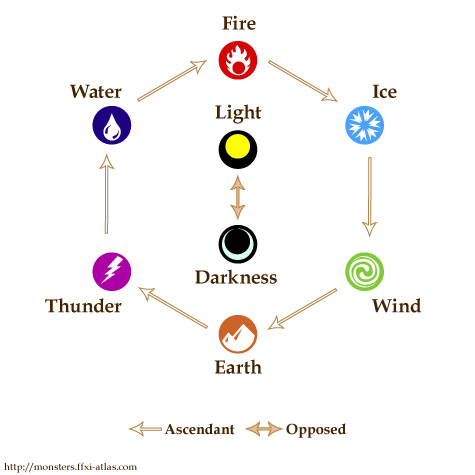
There are many systems going on under the hood in FFXI's combat. The world has a week cycle which progresses through 8 elementally-aligned days; each day lasts about 1 Earth hour. Each spell has an element associated with it, and using the skill during the element's day or the day that is weak to the skill's element will cause the spell to be more effectual. The other side of the coin is that if that spell in casted during the day that is strong against that spell's element, then the spell will be less potent.

Weapons have damage types which grant bonuses or dampen damage against certain foes. Popular leveling locations at the moment are filled with Colibris which are weak against piercing attacks. Thus Dragoons and polearm-weilding Samurai are hot jobs right now.

Less pervasive knowledge, but still important to those that can exploit it, the mobs themselves have a counter system. Attacking a bird with a crab wouldn't be a Beastmaster's first choice.

It's not the end of the world if a Dark Knight (using a Scythe) is invited to a Colibri party or a mage casts Fire II on Watersday. These are intricate systems that provide slight advantages (or disadvantages) to those who understand and capitalize on situations. Over a long enough timeline the optimizations add up, rewarding those who are more knowledgable, but sometimes it is unavoidable--healers will still cast Cure on Darksday regardless of the 10% less potency.

These systems make combat more nuanced--more mechanics to be learned and applied on the road to mastery. Spell rotations and weapons have more considations than just DPS at face value. Melee classes maintain several different weapons and use the appropriate blade depending on party composition and camp location. Monsters have more dimensions than just HP, and thus the world has a bit more personality and feels more alive.

How did we let studios remove these types of systems? Was it deemed too much baggage to get on the treadmill? Too complex for plebian minds?

Saturday, June 26, 2010

Cheating Death (Pt 2): Kill It

Either make player characters truly immortal or build the game around death being a meaningful and inevitable event. In this article I’ll discuss removing death from PvE MMORPGs.

We can see that moderating the effect of death leads to a watered down, minimal slap-on-the-wrist. Death is not a notable event more than taking a flight path is an event. Serious players deride weak death concepts because if death doesn’t have meaning, then, in an analysis of mechanics, combat where the only punishment for failure is death cannot have much meaning.

PvE MMORPGs generally have long, steep vertical advancement. These games are reward ladders intertwined in an interesting fashion. The decisions the player makes aren’t on the “what should I do to kill this lizardman”-level, but instead on the higher level of abstraction on which rests character advancement and time budgeting. Long and dramatic advancement encourages the player to invest a lot of time in a single character. The player naturally hates the concept of losing that character—and the time it represents—in whole or in part. PvE MMORPGs are supposed to be fun, and seeing 300 hours evaporate in the context of a game is not fun.

In a PvE MMORPG, skill growth is easy and short. You learn how to play the basic aspects of your character in the first few levels. Over the next several hundred hours of your character’s life, the game will grant you access to new abilities at a slow trickle, giving you plenty of time to fully adapt your play to use whatever has become available. The content doesn’t give you a reason to learn to play at anywhere near an optimal level, either. Because players don’t have much room to grow their skill, there’s little skill carry-over to make being forced to start a new character (because your old one is permanently dead) anything but a chore compounded on existing chores.

Death is a pointless mechanic in PvE MMORPGs. It means very little and usually has a crappy lore justification. When designers tack penalties on to death in order to give it meaning, players will avoid interesting, risky content, and when they do die they will end up unhappy for no particular gain. Let’s get rid of it.

Make the game so that the player character can’t die. The player can fight indefinitely against any enemy and eventually probably win, but he can’t be killed and forced to respawn. Give the player an ability that allows them to teleport out of battles (or bad places that would usually cause death) at will. Let the  player disengage an enemy’s aggro, but then bump the enemy’s health and expendable resources back to where they were before the battle. Build the game around rewarding players for efficiently dispatching with enemies. It’s already this way in effect, why not make it the central issue?

Removing daeth would make PvE MMORPGs a smoother and more enjoyable experience, while sidestepping the awkwardness and mechanical faux pas that a concept of death needlessly brings to such games.

Friday, June 25, 2010

Reaching Destinations

Travel seems to be a very controversial topic in MMORPGs. The current trend is to enable instant-action as much as possible and toss "immersion" or other virtual worldly concerns out the window. That's all fine and dandy for a game of TF2--I don't want to walk to Dustbowl every time I want to play the map. But for games that are supposed to have "worlds", that world becomes very small.

Humans relate large distances with time, not actual distance units. I wish I could uncover a paper or study on this phenomenon, but I couldn't find one. Anecdotally whenever I plan a trip, I measure the cost in time. It will take 3 hours to get to my destination. Google Maps displays route times in larger font than the distance. One of Science's largest distance units, the light-year, derives directly from a time calculation. This could be that our society is obsessed with speed and efficiency, and time isn't something to be squandered--especially on a video game--but then all the more important to factor in Time to an activity in an MMORPG.

I think that if an MMORPG is to have a 'world' quality, traveling needs to be significant. If the game is supposed to be a feel-good achievement treadmill, then cut the fat and insta-port the player when- and wherever. That's not a game I want to play. If I want empty trophies, I'll load up FarmVille or Progress Wars. If I want PvP competitive gaming, I'll launch TF2. But if I want something resembling a virtual world, I want travel times. There are plenty of things I do in my life grudgingly, but the difficultly of the journey both creates exclusivity and sweetens the reward.

Tips for Travel in FFXI

Each white box marks a Region which is composed of several Zones. Not shown: Aht Urhgan.
To follow up my last couple posts on FFXI, I am listing some alternative transportation systems.

Teleport Crags: Works like a waypoint system. Players must collect a "gate crystal" from the crag and then be near the party member casting the Teleport spell. Spells can be learned on lv36 White Mages (and some more exotic locations at later levels). The passengers can be any level; only requirement is the gate crystal. There are 3 crags near the 3 starter cities, 3 in high-level lands, and 3 in the Shadowreign zones. There are also items which can Teleport players to crags if a White Mage cannot be found.

Outpost Teleport: This is also a waypoint system, but waypoints can only be activated at certain times. Once a week, there is a "Conquest tally". The 3 nations and the Beastmen gain influence in Regions (groups of zones) and the faction that has the most influence at the start of the tally controls the Region for a week. Players can do Supply Runs to an outpost under their nation's control, henceforth allowing teleportation to and from the outpost for a small fee (the destination remains unlocked forever). One of the most used forms of travel.

Warp: A lv17 self-cast Blackmage spell that can also be cast from items. Returns the player to their Homepoint. Any player can purchase a Scroll of Instant Warp using Conquest Points (a currency acquired while gaining experience points). At level 40, Blackmages can learn Warp 2 which can be cast on party members.

Ghetto-warp: A term given to the act of switching to a level 1 job, running outside, dying, and releasing to your Homepoint.

Escape: A situational lv29 Blackmage spell that only works in dungeons or other "indoor" zones. Transports the mage and nearby party members out of the dungeon. Each dungeon has only 1 Escape destination, so it is possible to use the spell to skip traversing a zone altogether.

Airships: Once a player gets to Rank 5 (a milestone in the Mission questlines), they gain an Airship pass. They are then allowed to ride the airships in Jeuno to any of the 3 starter cities for a small gil fee. Alternatively, a player can purchase a pass for a lot of money.

Chocobos: Players can get their Chocobo License at level 20, which allows them to rent chocobos from stables for a small fee. While on a chocobo, the player travels at 200% speed (that is my guess) and will not aggro any mobs. Chocobos cannot enter towns/cities, dungeons, or any zone considered "indoors". Once a player dismounts, the chocobo runs away, and the player must rent a new chocobo from a stable in order to ride again.

Repatriation: By completing "Training regiment" kill quests at Fields of Valor manuals, player gain a currency called Tabs. At any Field Manual, a player may "Repatriate" for a tab fee. Repatriation teleports the player to their home nation.

Lure of the Wild Cat: Four quests in each of the 3 starter cities and Jeuno which unlock the ability to teleport for a small fee to the distant city of Aht Urhgan Whitegate (a major high-level hub).

Runic Portals: A very explicit waypoint system allowing players to transport between Whitegate and various locations in the Treasures of Aht Urhgan zones.

Campaign Teleport: The Wings of the Goddess zones are 20 years in the past. They are called the Shadowreign zones, and a major war is going on in them. Players can join the fight and earn Allied Notes. Players can then teleport to any Shadowreign zone they've visited (they just need to zone into the place; don't even need to talk to anyone or pick up an item) for a small fee in Allied Notes. Players can enter the past/present by going through portals in each zone called Cavernous Maws.

Retrace: Lv55 Blackmage spell. Similar to Warp 2 except that instead of being transported to their Homepoint, players are taken to their "nation of affiliation in the past". Useful for getting to the Shadowreign zones more quickly than using a Cavernous Maw.

Ease of Exploration: Once a week there is a special event where Moogles hide special items called Mog Tablets around the world. Players are tasked to find and return them (and get some very nice rewards for doing do). Once all 11 tablets are returned, three Super Kupowers are picked at random and affect the world for a week until the event starts again. One of these Kupowers is called Ease of Exploration which allows players to teleport to the 3 starter Cities and 2 smaller towns for a small fee.

Run speed modifications: aside from Chocobos which also give players the benefit of aggro-free travel, there are abilities and items which can temporarily boost a player's run speed. Flee is a level 25 Thief ability; Dancers get a jig at 55 to increase run speed; Bards can sing a song to make all their party members run faster at level 37 (and a better one at 73). There are also a handful of items which give the Quickening buff.

Some odds and ends: Nexus Cape, Tidal Talisman.

Thursday, June 24, 2010

Mastering the Environment

Traveling and exploring in FFXI can be dangerous. A death can end an adventure prematurely or leave you with a mouthful of dirt, desperately asking any passers-by for a Raise. One tip I told my friends who recently took the plunge into Vana'diel is that mobs in FFXI wander much further than in WoW. You could be solo'ing peacefully, and then out of nowhere a Goblin catches sight of you and sticks his gobbie dagger right in your backside.

Notice that I said "sight". One interesting system in FFXI is how mobs actually aggro players. There isn't a single "aggro radius", an invisible border to recklessly run through dodge. Aggro triggers include Sight, Sound, Low Health, casting magic, and Weapon Skill usage. Each type of mob might have none or some of these triggers, and the game doesn't tell players with GUI features how mobs detect. In WoW, aggressive mobs have red name plates; in FFXI, all mobs have yellow name plates and players have to learn the rules. E.g. most Beastmen (humanoids) detect on sight, and it is possible to run right up to their backs safely (just hope that they don't turn around). Undead detect on sound, but will come after low HP players from a much greater distance.

Avoiding low health and magic seems simple enough--don't cast anything. Players also get an arsenal of spells, abilities, and items which silence their sounds and hide from enemies. Any Sneak effect will cancel sound detection, and any Invisible effect will cancel sight detection. Keep those 2 effects active (they last random durations ranging from 15 seconds to 5 minutes), stay out of earshot and sight when re-applying, and players can travel and explore to their hearts' content.

But just like something out of Donkey Kong Country 2, FFXI takes advantage of players' expectations of the rules. Some mobs have True Sight or True Hearing, meaning that Sneak and Invisible are useless. Last night I decided to do the quest to unlock the Puppetmaster job. I must pass though some dangerous areas with True Sight imps and pick up a Key Item from a quest location.

FFXI uses a ??? target (yes, 3 question marks) to trigger events, cut scenes, boss fights, and pretty much anything else that is remotely related to a quest. Players need to be on the appropriate quest and not invisible in order to activate the ???.

Well I died 3 times on my way there. Luckily I was able to grab a Raise from a nearby Red Mage the first time, and then was able to self-raise the other 2 times (using a proactive buff called Reraise).

Normally I have no problem avoiding sight lines, but in this particular zone, there is heavy vegetation which obstructed my view. I run down an alley which I perceive as clear, and then get hit for a fourth of my health. "Crap."

Mobs will pursue targets until the player is quite some distance away--well outside any aggro radius. Originally, they would never stop, and players would have to change zones in order to shake enemies. Yes, FFXI had "trains to zone".

Getting around isn't just a simple time sink. FFXI has vast lands, but they are filled with interesting obstacles that reward players who take the time to discover their traits. There are passages and shortcuts not shown on maps; mobs have different aggro triggers which can be exploited to turn a seemingly impossible journey into a cake walk.

A simple delivery quest can morph into an epic adventure. It's not a flight on a gryphon, and it's not a mounted autorun across the zone. It is a quest to return the ring to Mount Doom, avoiding enemies along the way. It is an opportunity to explore desolate and dangerous places. It is a chance to test your knowledge of the world and master the environment.

Tuesday, June 22, 2010

Cheating Death Pt. 1: Introduction

We must look at death both from a game mechanical perspective and a metaphoric perspective.

Death is a consequence for defeat in combat. The current structure of MMORPG combat is similar to how combat works in bad movies. The hero fights a bunch of nameless trash and the fight ends when the trash are all dead. The trash are designed to be killed. Designers have made every fight essentially a fight to the death—players expect this and would be confused by having it otherwise. Other outcomes are nothing but cheap excuses for death—mere icing on top of the death-cake meant to make it look as if it is not death but instead some form of retreat or injury. But the effect of the prettified death-cake is still practically similar to unadorned death-cake: namely, death.

Regardless, we all know that the death-cake is a lie. It’s the cooing noises a parent makes at its child to ease the child down from the brink of a tantrum. We are no more than petulant children, looking to have some vague feeling of mock-accomplishment we can pass off as “fun”. Death is an unpleasant detour on the path towards that mock-accomplishment, and so designers find death a difficult obstacle to either include or exclude.

Some people want their character’s death to be a mountain, some want it to be a speedbump. The mountainous death is meaningful, the speedbump death is the smallest obstacle possible on the road towards the accomplishments that many think give meaning to MMORPGs.

Lord of the Rings Online cheats death on the player’s end by making the player’s death not actual death, but a mere shock to the character’s morale. The effect is the same: you lose the fight and your character becomes unusable until someone brings him back to the fight with an ability or the player elects to be teleported at some penalty back to a place of relative safety.

How do you design death into an MMORPG without “cheating”? Without being too punitive? Without it being meaningless?

  • Come up with death mechanics that actually make sense and aren’t such a cop-out.
  • Get players used to the concept of death being meaningfull and not just a speedbump.
  • Come up with a metaphor to make the mechanics fit tidily into a game world. Hell, you could even design the game around death mechanics if they’re going to be serious and important to how the game plays.

I’ll go into more detail on each of these points in a future post.

Saturday, June 12, 2010

Global Agenda Won’t Dare to be Different

HiRez is normalizing Global Agenda to MMORPG standards and this will kill the game. In a few crucial ways, this normalization is half-baked and has no hope of capturing the MMORPG crowd.

A summary of the game’s concessions to the MMORPG normal:

  • A per-item loot system instead of a whole-character upgrade system.
  • A randomized loot system instead of craft or AH purchase-based gear acquisition.
  • Maxed gear is now much more difficult to get—you used to be able to get maxed gear for one build in a month or two of 60 minutes per night play. Now you may never get it.
  • Open-world “zones” (instances with higher player caps than 20) will be added in later phases of 1.3.
  • Solo missions were added and open-world solo missions will be tacked on in a later phase.
  • Token-purchased “wellfare epics” were added to the game.

HiRez doesn’t understand how these additions appeal to the players they are meant to draw. They’ve missed the point of doing what they’re doing.

  • The loot system is boring, linear progression. Loot needs to be cool-looking, powerful, and very diverse to keep MMORPG players interested.
  • You can’t trade loot, which means that you are forced to keep crappy drops without hope of trading them for something better. The “advancement at all costs” mindset that makes MMORPGs so addictive relies on trading up through the loot ladder by harnessing the value of past loot. With all equipment being bind on pick-up, an economy that is already a joke has no hope of maturing.
  • Solo missions appeal to players because they allow for advancement alongside others, but not having to work together. Global Agenda’s solo missions are instanced so the player is entirely alone versus legions of enemies. The missions are so difficult once you get to a respectable level that none but the more hardcore players—given some practice over several failed runs—can hope to succeed.
  • The open-world zones will just be instances that allow more players on the same map. The largest number of players on any playable map in GA right now is 20, so the number of playres allowed in the open world zones can’t possibly be much larger. The UT engine also does not tend to support large numbers of players (over 64, I think). This will be by no means “massive”.

Let’s look at the real problems with the game as it exists even after the first phase of the messiah patch 1.3.

  • The loot system is boring. Loot doesn’t do much to differentiate you aside from making you flat out more powerful. But you can’t even become that much more powerful. It’s 4% gains. Flat, small gains do not make for an exciting loot system. It’s just an excuse for a grind.
  • The economy is a joke. There aren’t enough interesting items to trade with other players. Everything’s too locked down and confined to being used by specific characters. Goods can’t be traded freely enough for the economy to take on the kind of full-bodied nature that makes World of Warcraft’s economy remotely interesting. Global Agenda has not been doing anything to improve the viability of the economy in new patches, either.
  • There aren’t enough PvP maps. We have had maybe 3 or 4 PvP maps added in five months. Existing maps are slightly altered as an excuse for “more maps”—this is transparent bullcrap, laziness, and it’s lame. Make maps for your players to play; make good, thoughtfully designed maps that look like you actually gave them some effort.
  • There aren’t enough tilesets—the maps all look surprisingly similar. Crates, metal floors, metal walls, open doors, mainframes, invincible glass barriers—that’s all these maps consist of. The new maps recently added look like they came from an entirely different game. All of the other maps need to be overhauled to reach this standard of design and art.
  • There aren’t enough (innovative/unique) modes. There are six PvP modes. No new ones have been added since release. The existing modes are all point-based and most of them are rehashes of modes we’ve seen in other games, like Team Fortress 2.
  • The story is not integrated into the gameplay. The only story you see is in the tutorial. After that, the game does absolutely nothing to get you into any story whatsoever. Global Agenda is transparent through to the game mechanics.
  • Alliance vs. Alliance is a failure as a competitive mode. The US zones were not competitive before 1.3’s release because all the good players piled into one agency/alliance. The competition was too fragmented to provide much of a fight on a scale broader than a few individual battles. Because there is no reward for finishing anywhere but in first place, there’s no reason to compete—just join the best faction and get your shiny helmet.
  • Half the devices in the game do not have a role to play for anyway—they are not viable in any build for any reason. And there have been little-to-no balance adjustments since the game’s release. This is inexcusable.
  • PvE is boring. The maps are linear. Tactical variety doesn’t exist. The AI is bad, though it has seen limited improvement recently.
  • PvE’s difficulty is primarily due to increased enemy damage, health and increased spawn rates of elites. Hirez did the cheapest possible thing that would increase the difficulty of PvE. They could’ve improved the maps, AI, and added new PvE objectives. They did not.

Global Agenda will not fail because it’s not enough like MMORPGs—it’ll fail because it tries to be like an MMORPG yet doesn’t have the one critical aspect of such games covered: content. Global Agenda has nowhere near enough content to keep a PvE player satisfied—it barely has enough content to keep PvP players playing.

In a market full of much more polished addictive MMORPGs executed significantly better, Global Agenda doesn’t have a leg to stand on. Global Agenda needs to innovate in order to succeed. As events unfold, it’s clear that HiRez does not understand this. They’re satisfied mainstreaming the game right out of its niche and into a market where it cannot compete.

Global Agenda’s lack of vision and direction will kill it. I’ve finally, after playing since release day and earlier, left the game because of the clear disdain for innovation and interest in appealing to a kind of player that cannot be satisfied with a Global Agenda that I would like to play.